
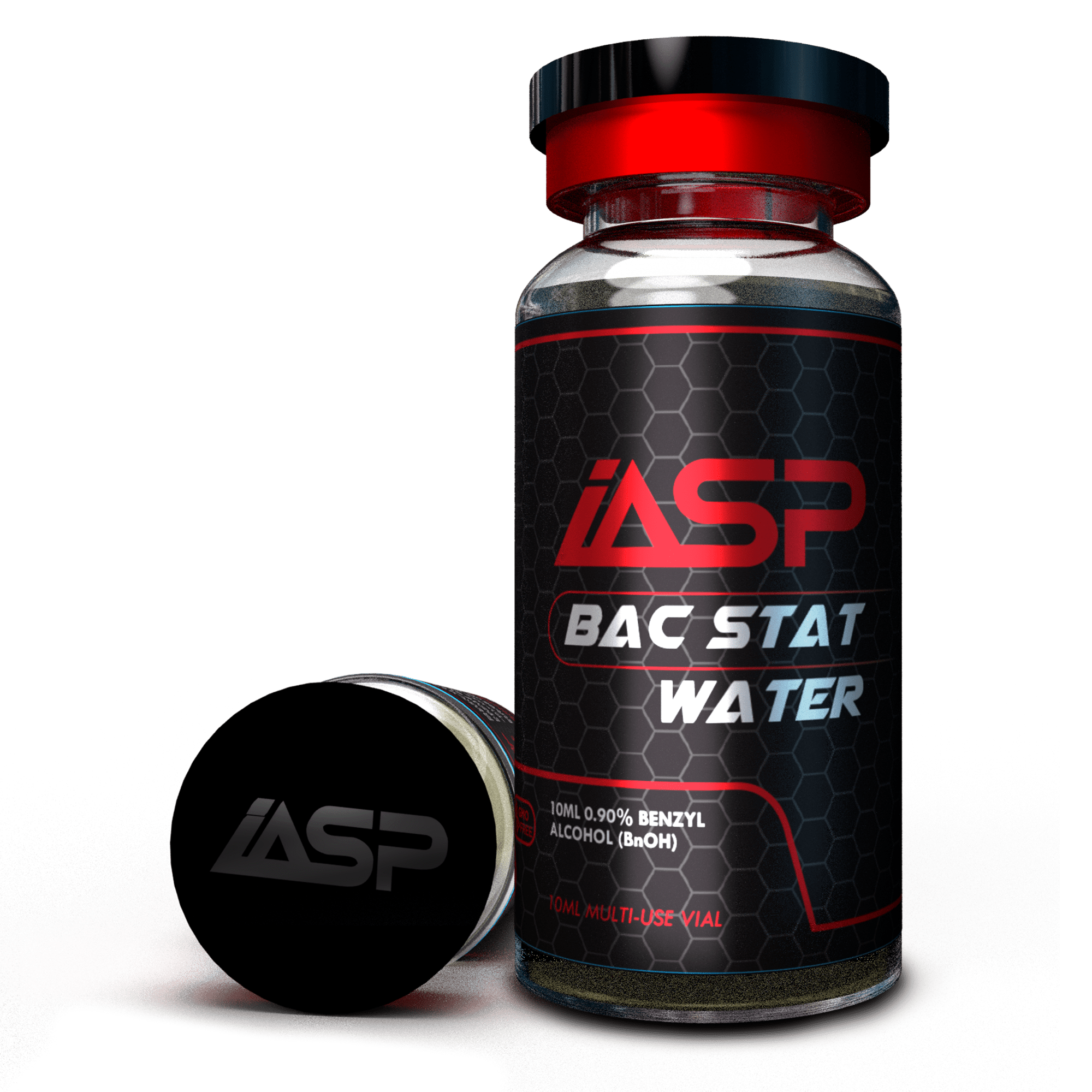
Benzyl alcohol, at the 0.9% concentration in bacteriostatic water, binds to hydrophobic regions of the peptide and destabilizes its native structure. This favors a partially unfolded intermediate state where aggregation-prone segments — hydrophobic patches or beta-sheet forming sequences — get exposed. These exposed parts then stick together via hydrophobic interactions, forming insoluble aggregates that scatter light and make the solution cloudy or clumpy.
Lyophilization itself can leave the peptide in a slightly perturbed conformation in the dried cake. When you add benzyl alcohol during reconstitution, it amplifies that instability, driving more aggregation than water alone would.
Sterile water has no such additive, so it lacks that extra push toward unfolding. The peptide stays closer to its soluble native or near-native state, keeping the solution clear.
We recommend sterile water to avoid this specific interaction entirely. Bacteriostatic is only worth it if you’re pulling multiple doses over many weeks — the preservative protects against bacteria, but at the cost of potential aggregation for sensitive peptides.
Sterile, 22 micron filtered water 0.9% Benzyl Alcohol by volume.
Curious about Bacteriostatic Water 0.9% BA?
Join our Philippines Facebook group to engage directly with thousands of others who use this product, and follow our Facebook/IG pages for hot updates and product announcements!
